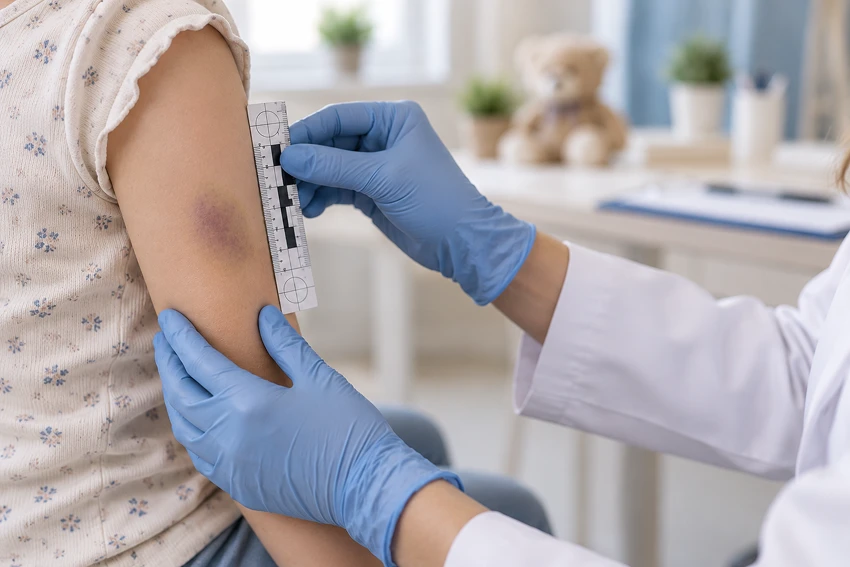
Forensic cases involving children require particular professional care. Alongside the medical assessment of injuries, safeguarding and developmental considerations may also be relevant.
A forensic medical assessment may be requested, for example, to clarify whether documented injuries are compatible with the reported accident or raise concern for inflicted injury, when they may have occurred, and whether they are consistent with the reported event. Depending on the circumstances, I work with a child and adolescent psychiatrist, a clinical child psychologist or another collaborating medical expert.
What questions can I address professionally?
Below I summarise the most common questions that may arise in a forensic medical assessment in this field.
When might a forensic medical expert be required?
A forensic medical assessment may be required, among other reasons, to clarify whether a child’s injury may have resulted from abuse, neglect, an accident or another external force.
Are the injuries compatible with the reported accidental mechanism?
The location, nature, shape, number and mechanism of the injuries can be assessed to determine whether they are consistent with the reported accident or raise concern for inflicted injury. In some cases, however, more than one mechanism cannot be excluded with complete certainty.
Can it be established when the injury occurred?
The age of an injury can generally be estimated only within a particular time range. The precision of the assessment is affected by the nature of the injury, the time of examination, the available medical records and the quality of the photographs.
Is the injury consistent with the account given by the child or caregiver?
The expert examines whether the reported event could have caused the documented injuries. Relevant factors include any object used, the direction and nature of the impact, the child’s body position and the anatomical location of the injury.
Can it be established whether the abuse was a single or repeated event?
The number, location, differing stages of healing and morphology of the injuries may support an assessment of whether one or several impacts occurred. Injuries demonstrably sustained at different times may raise concern for repeated injury; bruise colour alone cannot reliably date an injury.
Which injuries may raise suspicion of child abuse?
Particular attention may be required where injuries are found on several areas of the body and are of different ages, where there are possible defence injuries or marks reflecting the shape of an object, or where the injuries are inconsistent with the child’s age or developmental stage.
Does the expert take the child’s age and development into account?
Yes. When assessing injuries, it is important to consider whether the child’s age, motor development and physical abilities would have allowed the reported action or accident to occur as described. Different injury mechanisms are expected in an infant, a young child and an adolescent.
Can possible neglect be assessed?
Yes. The expert may assess the medical consequences of malnutrition, untreated illness, documented poor hygiene or lack of supervision or failure to obtain healthcare. Neglect may also require a comprehensive child protection assessment.
Can it be established whether the child’s life or health was at risk?
It can be assessed whether the injury actually caused a life-threatening condition and whether the force used, the object involved and the area of the body targeted could have caused a more serious or even life-threatening injury.
Can the healing period of the injury be determined?
The expert distinguishes the actual healing period from the medically assessed healing period relevant to criminal proceedings. This depends on the restoration of function and any complications, not solely on the disappearance of visible injury.
Is a personal examination of the child always required?
Not in every case. Certain questions can be answered from medical records, photographs and other documents. A personal examination may be necessary where the current condition, permanent harm, scarring or functional consequences must be assessed precisely.
Does the child have to talk about what happened during the forensic medical examination?
Not necessarily. The primary purpose of the examination is the medical assessment of the child’s health and injuries. Unnecessary repeated questioning should be avoided. A detailed exploration of what happened may be the task of another professional, such as a child psychologist or child and adolescent psychiatrist.
How is the child examined?
The examination is conducted sensitively and adapted to the child’s age, development and emotional state. Only the examinations necessary to answer the forensic medical questions are performed, with respect for the child’s dignity and personal rights.
May a parent or caregiver be present during the examination?
This depends on the nature of the case, the terms of the official appointment and the child’s best interests. In some cases, the presence of a caregiver may be reassuring; in others, it may influence the child’s communication or hinder the examination.
When should a child psychiatrist or child psychologist be involved?
A collaborating expert may be required where the child’s psychological state, trauma-related symptoms, development, suggestibility or psychiatric condition must also be assessed. The forensic medical expert assesses physical injuries and their consequences.
Can photographs of the injuries be assessed?
Yes, provided that the images are authentic, of adequate quality, in colour, in focus, dated and, where possible, include a scale. The nature and age of an injury can be assessed only to a limited extent from poor-quality photographs or images taken later.
What documents are required for the forensic medical assessment?
Relevant documents may include the initial medical records, outpatient notes, a medical injury report, diagnostic imaging, the hospital discharge summary, photographs, child protection records, witness statements and official documents relating to the event.
Does the expert determine who caused the injury?
The expert examines the nature and mechanism of the injury and whether it is consistent with the account given. Determining who committed the act is the responsibility of the investigative authority or the court.
Can the expert decide whether a criminal offence occurred?
No. The forensic medical expert provides an opinion on medical and scientific questions. The legal classification of the act and the determination of criminal liability fall within the competence of the authorities, the public prosecutor and the court.
Who may request a forensic medical opinion?
A court, public prosecutor, the police or another authority may appoint an expert. A lawyer, legal representative or private individual may also commission an opinion on a specialist question. However, the procedural status of a privately commissioned opinion may differ from that of an opinion prepared under an official appointment.
Every case involving a child is unique. The scope of the forensic medical assessment, the documents required and the involvement of collaborating experts are determined by the specialist questions raised and the best interests of the child.
Could not find your question?
Forensic medical cases vary widely. If you are unsure whether your question can be answered using forensic medical methods, a preliminary consultation can help identify the questions that can be examined and the appropriate forensic medical approach.
Get in touchFurther information about expert opinions
The Frequently Asked Questions page brings together the key information about contacting us, the documents required, fees and the expert procedure.
Frequently Asked Questions