After more than twenty-three years and approximately twelve thousand expert opinions, people often ask whether a forensic medical expert can still be surprised.
My short answer is always the same: yes. Even now.
Over the years, three lessons have been reinforced time and again.
The day I was reminded once again not to trust first impressions
If someone asked me for the most important rule in forensic medical expert work, I would probably not say knowing the legislation or the latest scientific literature. Those are, of course, indispensable.
But there is something I have learnt repeatedly over more than twenty years: a first impression is almost never enough.
At the beginning of a case, everything often appears clear. The injuries seem telling, the records are well organised and the account appears logical.
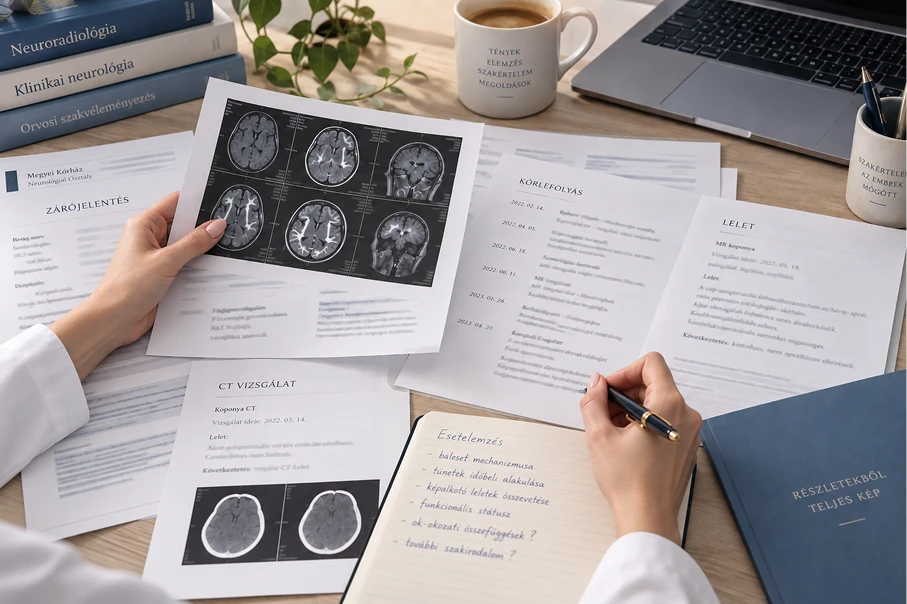
Then an earlier outpatient record emerges. A previous CT scan. A photograph. Or one sentence on the final page of a discharge summary. Suddenly, the evidence may need to be reassessed.
Even after more than twenty-three years, I sometimes begin a case thinking: “Yes, I have seen this many times before.” Half an hour later, I realise that I have not.
Perhaps this is one of the most rewarding aspects of the profession.
Experience helps us recognise connections. Yet the same experience can easily become a trap if we believe that nothing can surprise us any more.
I am still surprised. And I hope it stays that way.
Sometimes the most important evidence is not where everyone is looking
Most people imagine that a forensic expert always discovers some dramatic piece of evidence.
In reality, the opposite is often true. The most important detail may be a laboratory result. A date. An old outpatient record. A handwritten note.
A document that everyone has read, but no one has connected with the other information.
An expert’s task includes identifying and assessing the relationships between findings.
That is why I may read the same records several times. Not because I failed to understand them the first time, but because on the second reading I am looking for something different.
The most dangerous sentence in my profession
There is one sentence every forensic medical expert should be wary of.
“This is definitely what happened.”
Medicine rarely permits absolute certainty. We assess the available evidence, its consistency and the strength of any causal relationship.
A good expert is not credible because they answer everything immediately, but because they know when further investigation is needed.
Sometimes the most honest professional answer is neither “yes” nor “no”.
It is: “The available material does not establish this with sufficient medical certainty.”
That is not indecision. It is an honest account of the limits of the evidence.
The true value of experience
After all these years, experience means above all recognising when I need to slow down, reread the records or examine the information from a different perspective.
Professional knowledge must always be accompanied by attentiveness, healthy scepticism and humility. These allow me to assess every case on the basis of its own particular details.