Many people have heard the claim that the soul weighs 21 grams. The story does have a basis in the history of medicine: in the early twentieth century, an American physician attempted to detect the soul’s departure by measuring changes in body weight. His experiment, however, did not prove that the soul has measurable mass.
Where Did the Figure of 21 Grams Come From?
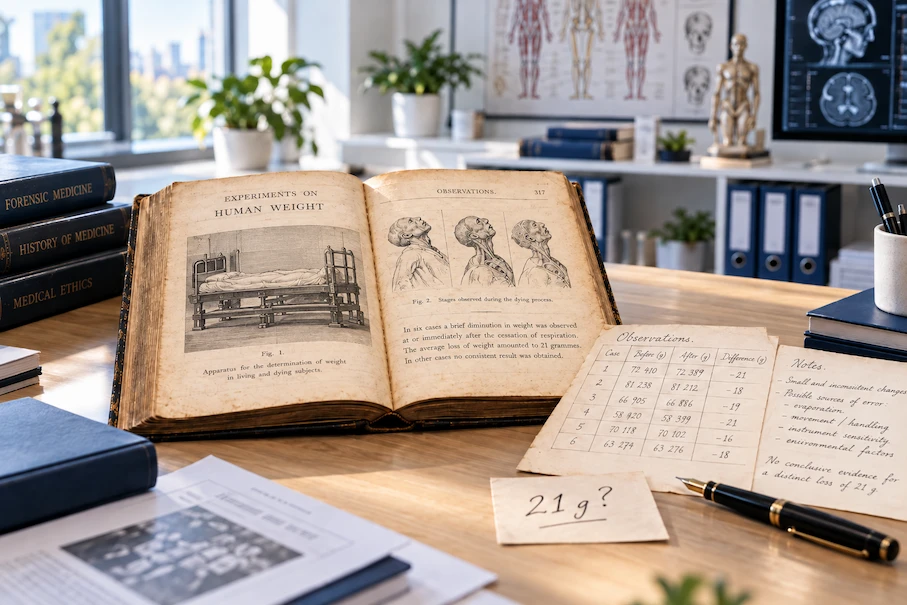
Duncan MacDougall, an American physician, published his observations of six dying patients in 1907. He began with the assumption that if the soul leaves the body at the moment of death and is material in nature, its departure might cause a loss of body weight. He monitored the patients on beds mounted on scales so that he could record any change occurring around the time of death.
In the first patient, he described a decrease of three-quarters of an ounce, equivalent to approximately 21 grams. He attributed this to the departure of a presumed ‘soul substance’. The widely known figure comes from this single observation, rather than from six patients producing the same result.
What Did the Measurements Actually Show?
In the other cases, MacDougall recorded changes that varied in magnitude and timing. He himself considered two of the measurements unusable. His report also mentions the difficulty of adjusting the scale and the uncertainty surrounding the precise moment of death. MacDougall acknowledged that further experiments would be needed to confirm his conclusion.
An observation involving six people therefore cannot support a generally applicable claim. The fact that a scale registers a change does not tell us what caused it. The reliability of the measurement, the conditions under which it was taken, and the consistency of the results must all be examined.
Why a Change in Body Weight Is Not Proof
MacDougall attempted to account for factors such as evaporation and breathing. These controls, however, did not turn the observation into a direct measurement of the soul. Even if a loss of body weight around the time of death had been reliably demonstrated, it would still have to be shown separately that the change was caused by the departure of an identifiable entity existing independently of the body.
An unexplained change does not automatically validate the proposed explanation. Scientific acceptance requires well-controlled studies that other researchers can replicate. The claim that the soul weighs 21 grams is not supported by reliable results of this kind.
What Does the Concept of the Soul Mean Here?
The question is further complicated by the fact that the word ‘soul’ has several meanings. In everyday language, it may refer to emotions, personality, and a person’s inner life. In a religious sense, it often denotes a spiritual entity that exists independently of the body and continues after death. This latter concept does not necessarily imply a material nature, so its existence cannot be determined by measuring body weight.
The absence of scientific evidence is not the same as proof of non-existence. At the same time, a belief based on faith cannot replace verifiable evidence when a claim is made about a measurable bodily phenomenon.
The Forensic Medicine Perspective
In forensic medicine, separating observation from inference is a fundamental requirement. After documenting a physical finding or measurement, we must assess which explanations are supported by the available data and with what degree of certainty. We evaluate the cause and circumstances of death on the basis of physical findings, test results, and information relating to the case.
This is the professional lesson of MacDougall’s story: he attempted to measure a change in body weight and inferred the existence of the soul from it. The evidentiary link between the two claims was missing. The idea that the soul weighs 21 grams therefore remains a widely known story rather than an established medical fact.
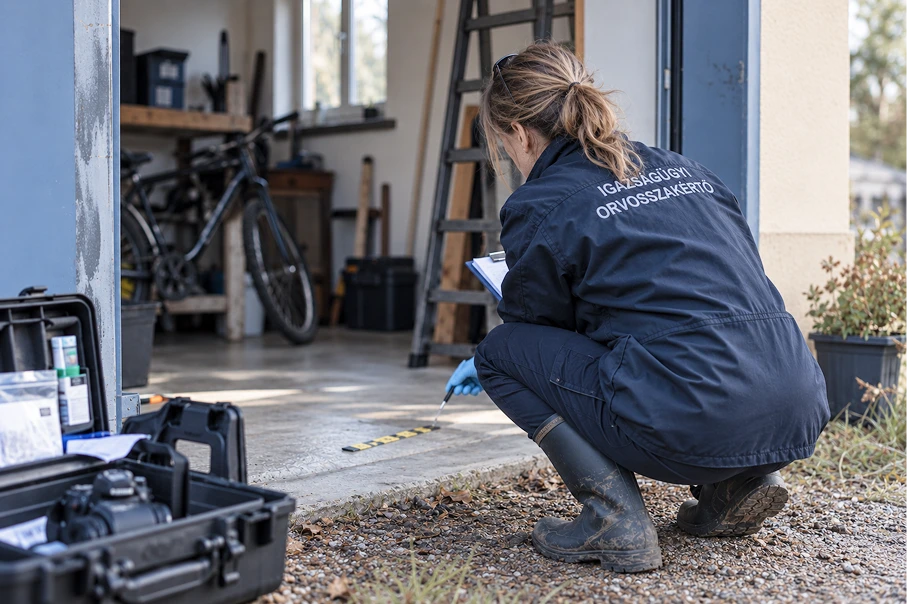
As a forensic medical expert, I can conclude from this experiment only that it failed to demonstrate that the soul has measurable mass. The measurement offers no decisive answer as to whether the soul exists. Part of my professional responsibility is also to recognise the limits of what the available evidence allows me to say.
For me, thinking about the soul is also connected with a person’s individual story: how they experienced the world, what relationships they formed, and what they meant to others. These qualities cannot be determined on a scale. Yet the absence of a proven medical answer to the question of the soul does not make it any less worthwhile to speak about a person’s inner life and the experience of losing them.
What remains of our individual existence after death is not a question I can answer with certainty as a forensic medical expert. I do believe, however, that alongside the scientific investigation of death, our thinking should also make room for the individuality and dignity of the deceased.