Crime series portray scene examinations as fast, dramatic and decisive. Within minutes, a clue appears and events seem clear. A real medicolegal scene examination is slower and more meticulous. The expert observes, measures and records findings, then considers them alongside the clinical records and other case materials.
Is a medicolegal scene examination really like the movies?
Anyone who knows the work of forensic medical experts only from films might easily imagine that a medicolegal scene examination resembles a Hollywood crime drama. The expert arrives in an elegant suit, walks across the scene in high heels, glances at the injuries for two minutes and then announces with a dramatic expression:
“I know exactly what happened.”
The reality… well… is rather more down to earth.
For a start, high heels are a rather poor choice in a muddy yard, at the edge of a forest or inside an abandoned building.
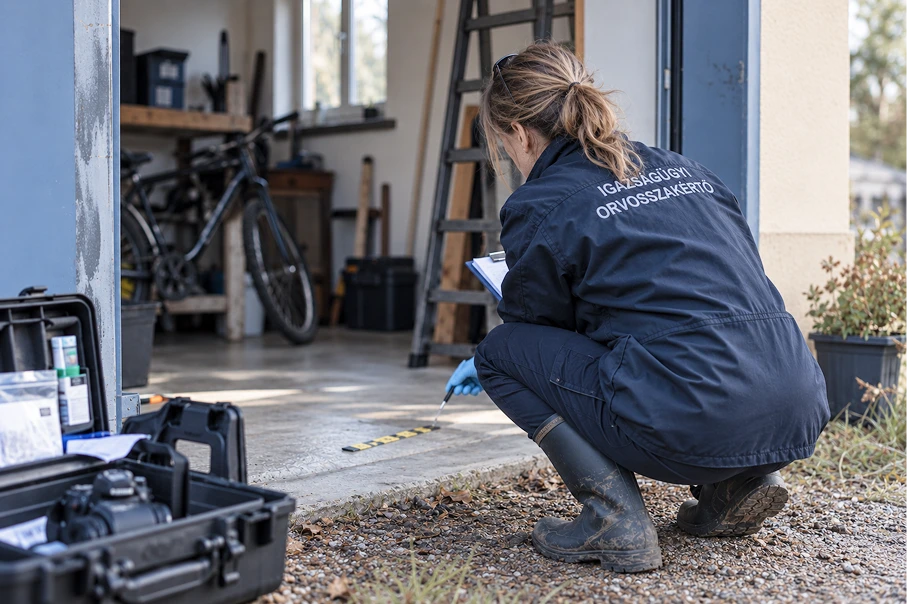
A medicolegal scene examination involves careful observation rather than dramatic detective work. We consider the scene alongside the clinical records, documented injuries, witness accounts and other available case materials.
Quite often, a walk-through of the scene raises more new questions than it answers. And that is perfectly all right.
A good expert attends the scene to document medically relevant findings and assess what conclusions they can support.
I should add that I have worn wellington boots during a medicolegal scene examination. High heels, not yet.
The practical side of a medicolegal scene examination also requires a few simple, tried-and-tested tools. The contents of an expert’s bag are far more ordinary than films might lead us to expect.
What is in a forensic medical expert’s bag?
Anyone expecting to find a magnifying glass, fingerprint powder or secret detective gadgets in a forensic medical expert’s bag has probably watched too many crime dramas.
The reality is more prosaic – yet much more interesting. One of my most useful tools is a notebook. Even with digital recording, a quick sketch or handwritten observation at the scene can later prove invaluable.
I carry a tape measure, camera, protective gloves, shoe covers, protective clothing, identification tags, a thermometer and a torch. Sometimes I also bring a change of shoes or a raincoat. On occasion, the terrain has called for wellington boots rather than elegant footwear.
And, of course, there is something that cannot be packed: experience. It cannot be borrowed or bought, and there is no spare supply of it in the bag.
The most important “equipment” is always the knowledge one brings to the scene. What makes an expert’s work special is not the tools themselves, but what the expert notices with their help.
The true role of a medicolegal scene examination
A medicolegal scene examination can raise new questions. Its findings help assess possible mechanisms of injury alongside the clinical records and other case materials.
The expert observes and records medically relevant details. An apparently ordinary circumstance may later prove important when the findings are assessed.